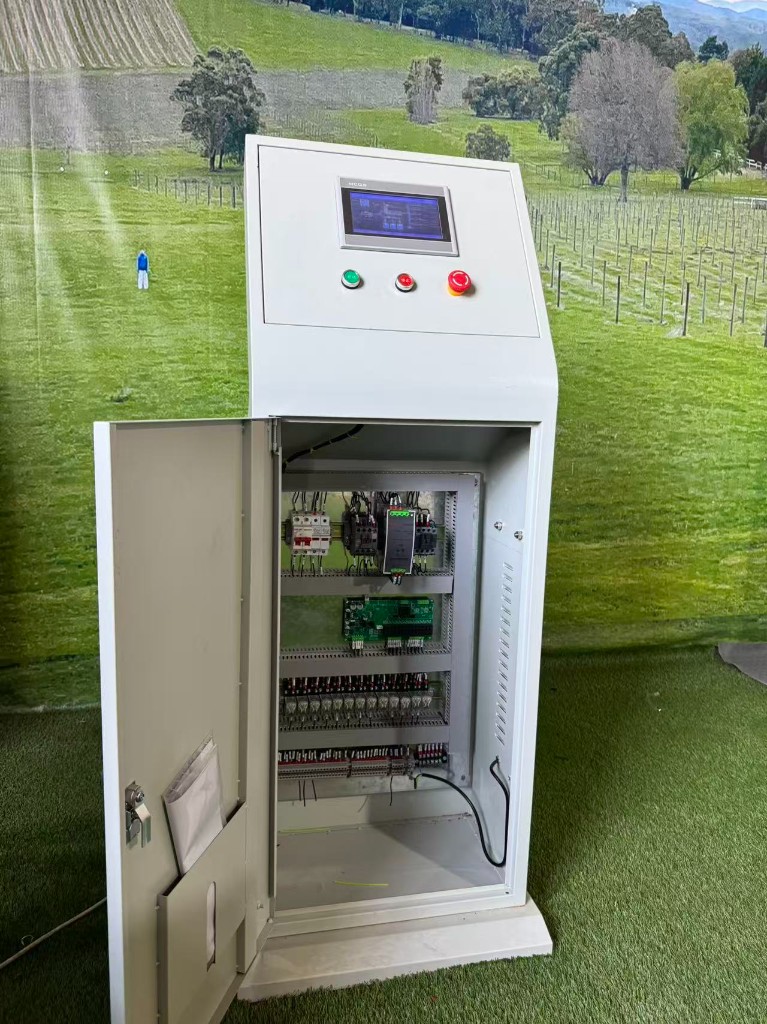
PKYDrip has extended its Grow 16 irrigation controller to cover the pump stations found across real farm and greenhouse projects — from a 2 kW submersible-pump water supply in a single cabinet to greenhouse climate loads above 100 kW. One controller platform, three power tiers, and no change to how the controller itself is operated.
The problem with one-cabinet assumptions
Irrigation projects rarely match a single cabinet size. A small nursery runs a 1.5 kW supply pump. An orchard block runs a 7.5 kW booster. A commercial greenhouse may start dozens of fans and ventilation units totalling well over 100 kW. Treating all three as the same electrical problem is what produces oversized cabinets on small jobs and overloaded starters on large ones.
Grow 16 now addresses this by separating control capacity from power capacity. The controller always delivers the same 16-zone irrigation logic; the cabinet plan follows the pump and load power of the project.
Three power tiers
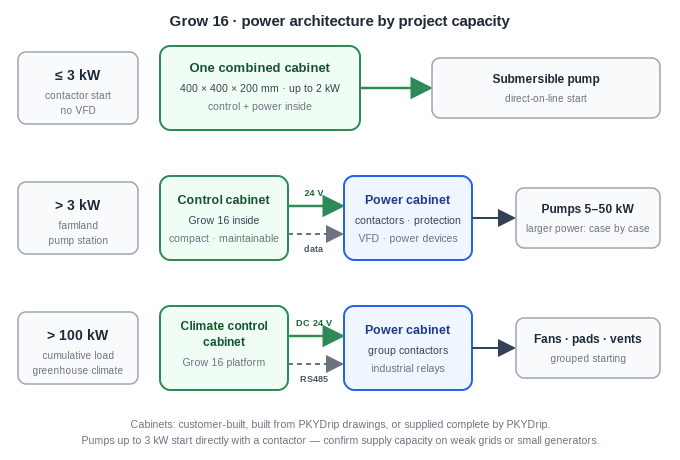
Up to 3 kW — direct-on-line starting, one combined cabinet. No variable frequency drive is required: the pump starts directly through a contactor. On the submersible-pump water-supply version up to 2 kW, control and power fit inside a single 400 × 400 × 200 mm enclosure. On weak rural grids or small generators, supply capacity for direct starting should be confirmed — this is standard practice for any direct-on-line starter, not specific to Grow 16.
Above 3 kW — split control cabinet and power cabinet. For farmland projects with pumps from 5 to 50 kW, the Grow 16 control cabinet stays separate from the cabinet holding contactors, protection devices, and drives. This keeps the controller cabinet compact, accessible, and maintainable while the electrical components sit where the cable runs are shortest. Pump power beyond this range is evaluated case by case.
Above 100 kW cumulative climate load — grouped starting. Greenhouse climate control starts multiple fans and ventilation units in groups rather than as one heavy inrush on the grid. Control cabinet and power cabinet are separate, linked by a single RS485 data cable and a single DC 24 V control cable.
What stays the same
The expansion is about electrical architecture, not about the controller interface:
- 16 irrigation zones plus a master valve output, expandable to 32 zones with the X16 board
- Wi-Fi and Ethernet as standard, with optional 4G
- Local control from a mobile browser — no app to install
- PKYDrip cloud for device, configuration, alarm, history, and version management
- Pump start with run and fault feedback, flow meter inputs, and 4–20 mA analog inputs
- Protection logic for flow, pressure, and pump faults
Future schedule and group changes are made at the controller, not by rewiring the cabinet.
Cabinet sourcing
Projects can source the cabinet in three ways: the customer or a local electrical contractor builds it, it is built from PKYDrip drawings, or a complete project-specific cabinet is purchased from PKYDrip.
Where it fits
Grow 16 remains the company’s primary connected controller platform, serving greenhouses, nurseries, orchards, small farms, and light commercial landscapes. The same platform also serves as the PKYDrip Greenhouse Climate Control System for larger climate installations. Standardized expansion boards add fertigation modules, climate modules, agricultural sensors, and additional head IO.
Full specifications for each power tier are on the Grow 16 product page. For a specific project, send the pump power, zone count, and load list and we will return a cabinet and expansion plan.